

Your investment thesis tells you what you are looking for and how much you need to invest to generate the cash flow you need to reach your goals. Building your portfolio is where that plan becomes real, and where patience separates a strong outcome from a costly one.
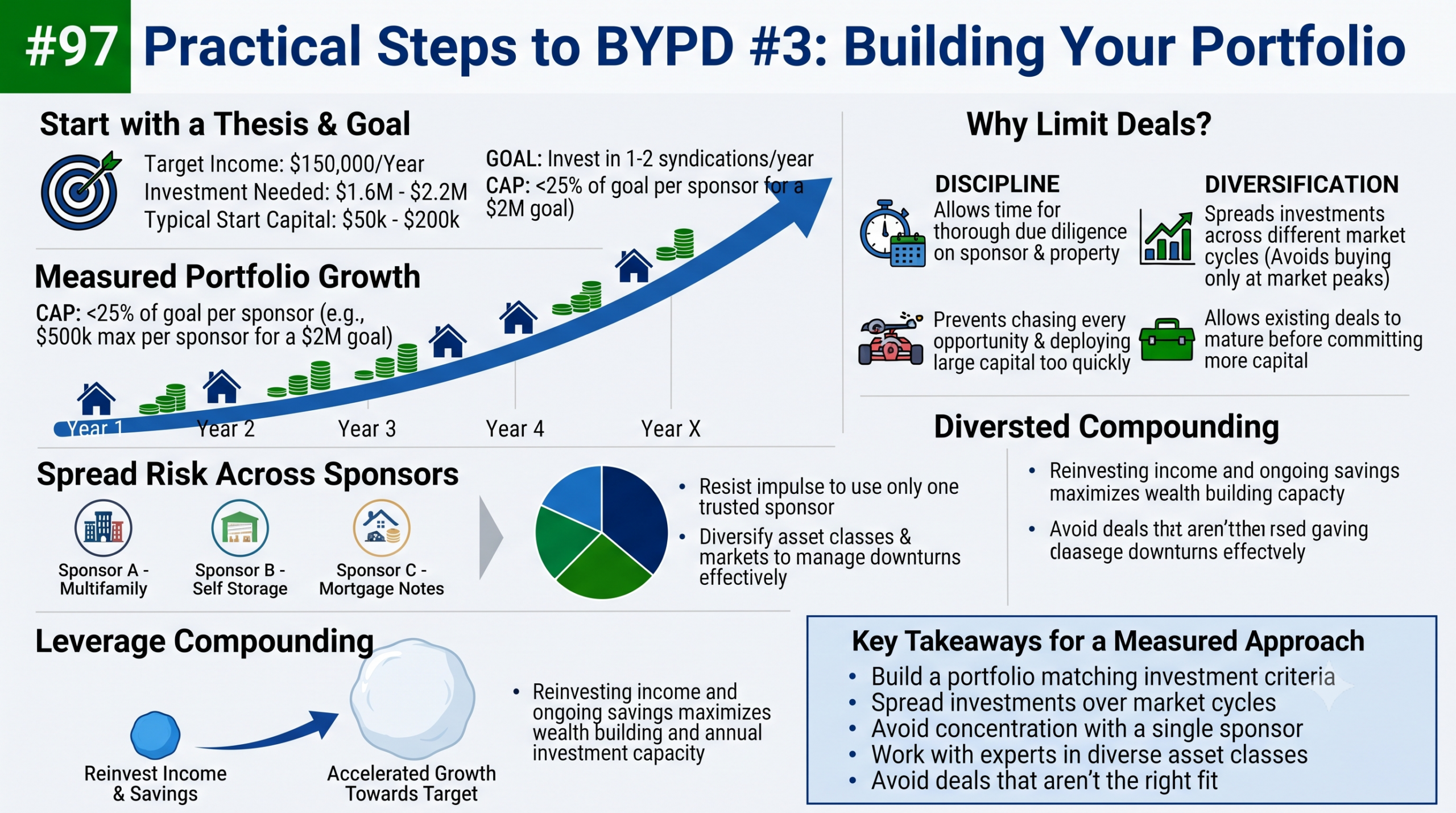
Continuing the example from the previous chapter, imagine a target income of $150,000 per year. Reaching that income typically requires between $1.6 million and $2.2 million in investments over time. Few investors start with that much capital ready to deploy. Most begin with between $50,000 and $200,000, then build from there.
My recommendation is to invest in one to two syndications each year, and keep your total commitment with any single sponsor below 25 percent of your long-term investment goal. For an investor targeting $2 million, that means capping exposure to about $500,000 per sponsor, not per deal. As you continue working, reinvest the income from your holdings along with your savings into new opportunities.
Limit the Number of Deals
Limiting yourself to two deals a year serves several purposes at once. Each deal requires real time to research, both the sponsor and the property, and that time competes with your job and your life. This limit also forces discipline. You cannot chase every opportunity that crosses your desk if you allow yourself only two decisions a year. It naturally spreads your investments across market cycles too. You are unlikely to buy at the exact bottom, but you are equally unlikely to buy everything right before a downturn.
My worst deals came from trying to deploy a large amount of capital at once. I believed that putting money to work quickly was the responsible choice. It was a mistake. I chased several deals that looked good on paper and technically met my criteria, but I cut corners on due diligence to move fast. Slower and more patient decisions would have led me toward better deals, and would have positioned me to invest during the following downturn, when far better opportunities appeared.
Spread Risk Across Sponsor
Once you find a sponsor you trust, handing them all your money is tempting. Resist that impulse. In the worst case, fraud takes your entire investment. Short of fraud, sponsors can grow overconfident and make poor decisions once they control too much money. Even if the sponsor does everything right, the best sponsors tend to specialize in a small number of asset classes and markets, which means their entire portfolio, and yours, remains exposed to broader market cycles.
Limiting your exposure to each sponsor forces diversification. I like a sponsor who focuses on self storage, but that market has struggled for the past several years. A separate sponsor who specializes in mortgage notes gave me exposure outside self storage, and that diversification helps me manage the downturn. I still expect my self storage investments to perform well over the long run, as those funds have several years left before they complete their cycle, but if I depended on them for my living expenses today, I would be in a far more difficult position.
Spreading your capital across sponsors and time also lets individual deals mature before you commit a larger share of your target. A three-year deal, for example, can complete its full cycle while you still have time to invest more with that sponsor. Past performance never guarantees future results, but watching a sponsor execute a complete deal gives you insights that you cannot get from the initial conversations. Some sponsors I have invested with had a style that did not suit me, and they will not receive additional capital from me regardless of how the deal performed financially.
Meeting new sponsors also keeps your network growing. Investing with only one or two people, however skilled, means missing out on the wider community of capable operators in this space.
Leverage Compounding
Compounding builds wealth only if you leave the money invested. Reinvest the income from your holdings alongside your ongoing savings, and your annual investment capacity grows each year. This moves you toward your target faster than your savings rate alone would allow.
Summary
Building a portfolio requires patience more than capital. A measured pace, spread across sponsors and years, gives you the diversification, the judgment, and the staying power that a rushed portfolio cannot provide. There is no shortage of good deals for those willing to wait for them.
By taking a measured approach, you are more likely to:
- Build a portfolio that meets your investment criteria
- Spread your investments out over market cycles
- Avoid concentration with a single sponsor
- Work with experts in a variety of asset classes
- Avoid investing in deals that aren’t the right fit for you
PS: I am building a free discord community of investors who enjoy adventure travel. If you are looking for a place to share travel tips, get feedback on investment options, and hang out with interesting people, let me know and I will send you an invitation.
The complete set of newsletter archives are available at:
https://www.mbc-rei.com/mbc-thoughts-on-passive-investing/
This article is my opinion only, it is not legal, tax, or financial advice. Always do your own research and due diligence. Always consult your lawyer for legal advice, CPA for tax advice, and financial advisor for financial advice.