
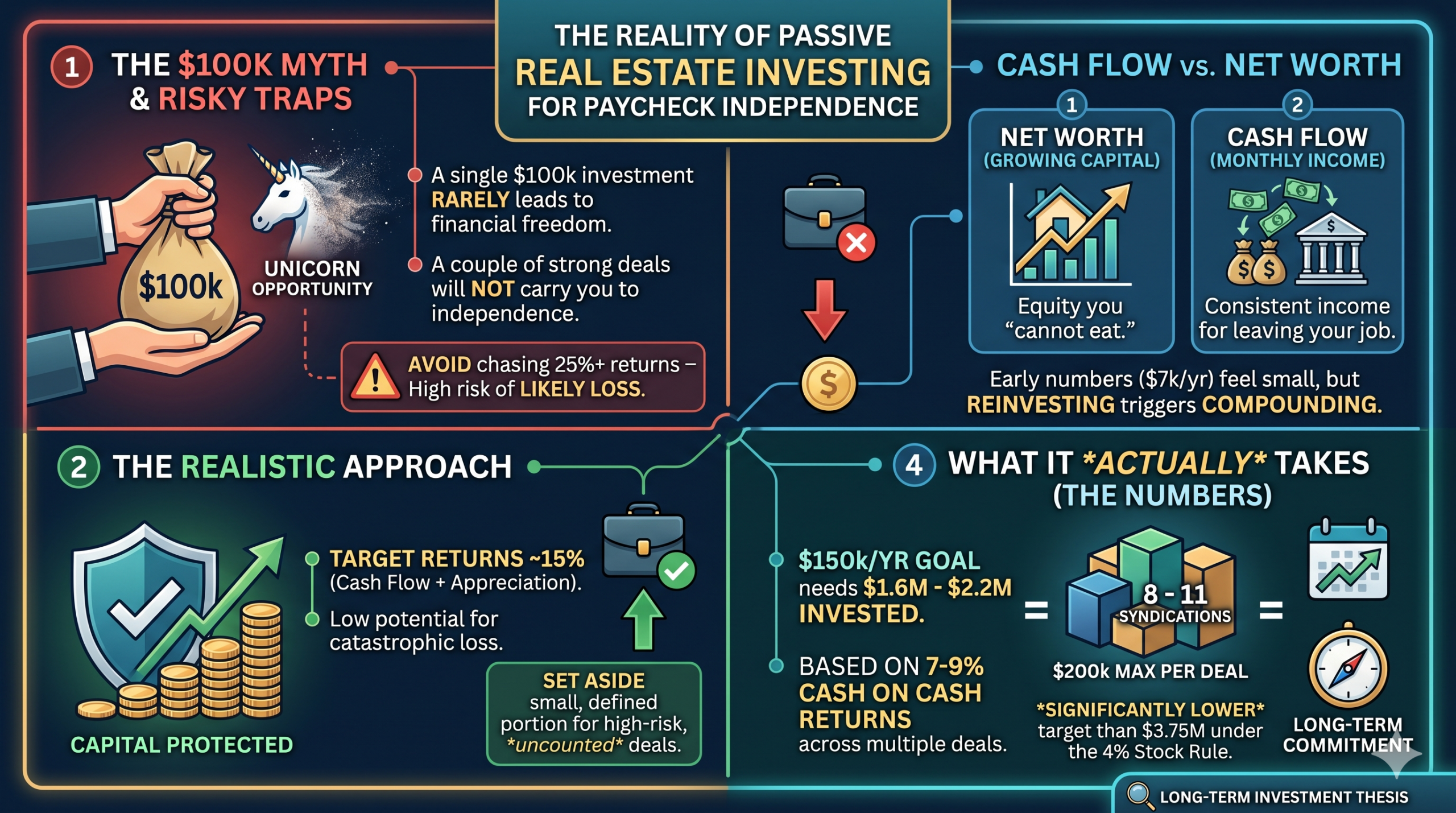
A single $100,000 investment will not make you financially free. This is an extremely important lesson every passive investor must accept. 99.999% of the time, a single investment of $100k will not provide you financial freedom (the exception being an early investment in a unicorn opportunity).
Too many new investors believe that a couple of strong deals will carry them to independence. When you operate from that assumption, you start chasing deals that promise unreasonably high returns. Any opportunity advertising returns above 25% is, at best, extremely risky. At worst, it is an outright scam. The odds of these returns actually materializing are slim. If your plan depends on generating $30,000 a year from a $100,000 investment, these are the deals you will end up evaluating. The more likely outcome is losing your entire investment rather than earning those returns. A loss like that does more than set you back financially. It leaves you discouraged and more desperate for the next big return, often pushing you toward even riskier decisions.
A better starting assumption is a target return of roughly 15%, accounting for both cash flow and appreciation. Deals built around this expectation tend to carry meaningfully lower risk. Some will outperform, reaching 20%. Others will fall short, perhaps landing closer to 5%. Either way, the chance of losing your principal entirely drops significantly. I recommend concentrating the bulk of your portfolio in deals with a low potential for catastrophic loss. If you want to pursue higher risk opportunities, set aside a small, defined portion of your portfolio for that purpose, and do not count on those deals when planning your path to paycheck independence.
Cash Flow Versus Net Worth
Growing your net worth matters, but it is not the same as building the cash flow you need to step away from your paycheck. As the saying goes: “You cannot eat equity”. Before you can leave your job, you need consistent income arriving in your bank account, not just a rising number on a balance sheet.
In the early years, that income will look small. Earning $7,000/yr, or less than $600 a month, can feel insignificant. A friend of mine once pointed out that she spends much more than that eating out. The key thing to keep in mind is that the early numbers are just the starting point. If you consistently reinvest your returns alongside additional savings, compounding takes hold over time. What starts as a few hundred dollars a month gradually becomes thousands of dollars arriving without any additional work on your part.
What It Actually Takes
Reaching full paycheck independence through syndications requires a meaningful amount of invested capital. Many stabilized syndications return between 7% and 9% in cash on cash returns, with additional gains realized upon sale or refinance. If you need $150,000/yr to maintain your lifestyle, you would need between $1.6M and $2.2M invested across deals generating that range of returns. Assuming a maximum of $200,000 per opportunity, this means spreading your capital across 8 to 11 syndications.
That number can feel overwhelming, especially early in your investing journey, which is why starting with the right mindset matters. This is not a get rich quick strategy. It requires consistent, dedicated effort sustained over many years. With compounding working in your favor, the goal is entirely achievable for most high income earners. It is also worth noting that this target is significantly lower than the $3.75 million you would need under the traditional 4% rule using stocks and bonds alone, and that comparison does not even account for the tax efficiencies syndications often provide.
These numbers are a starting point, not a finish line. No deal is perfect and you won’t always find ones that have consistent returns. By keeping in mind your investment thesis and recognizing that this is a long-term commitment, you are less likely to be lured into high risk deals and instead take the steps required to ultimately break your paycheck dependency.
PS: I am building a free discord community of investors who enjoy adventure travel. If you are looking for a place to share travel tips, get feedback on investment options, and hang out with interesting people, let me know and I will send you an invitation.
The complete set of newsletter archives are available at:
https://www.mbc-rei.com/mbc-thoughts-on-passive-investing/
This article is my opinion only, it is not legal, tax, or financial advice. Always do your own research and due diligence. Always consult your lawyer for legal advice, CPA for tax advice, and financial advisor for financial advice.