

Most people think of real estate as a single investment category. When the topic arises, the conversation usually defaults to one image: buying a rental house and collecting monthly rent. This picture represents only a narrow slice of an asset class far more varied than most investors appreciate.
Broadly speaking, you can break real estate into both residential assets, where people live, and commercial assets, everything else. There are also four cross cutting strategies that can be applied across asset classes.
Because the field is wide, no investor masters all of it. The goal is to identify the subset of asset classes that align with your investment thesis and develop real expertise there. Depth beats breadth in real estate investing, every time. As your knowledge of a specific asset class sharpens, you will recognize good deals more quickly and filter out the ones that do not serve your goals.
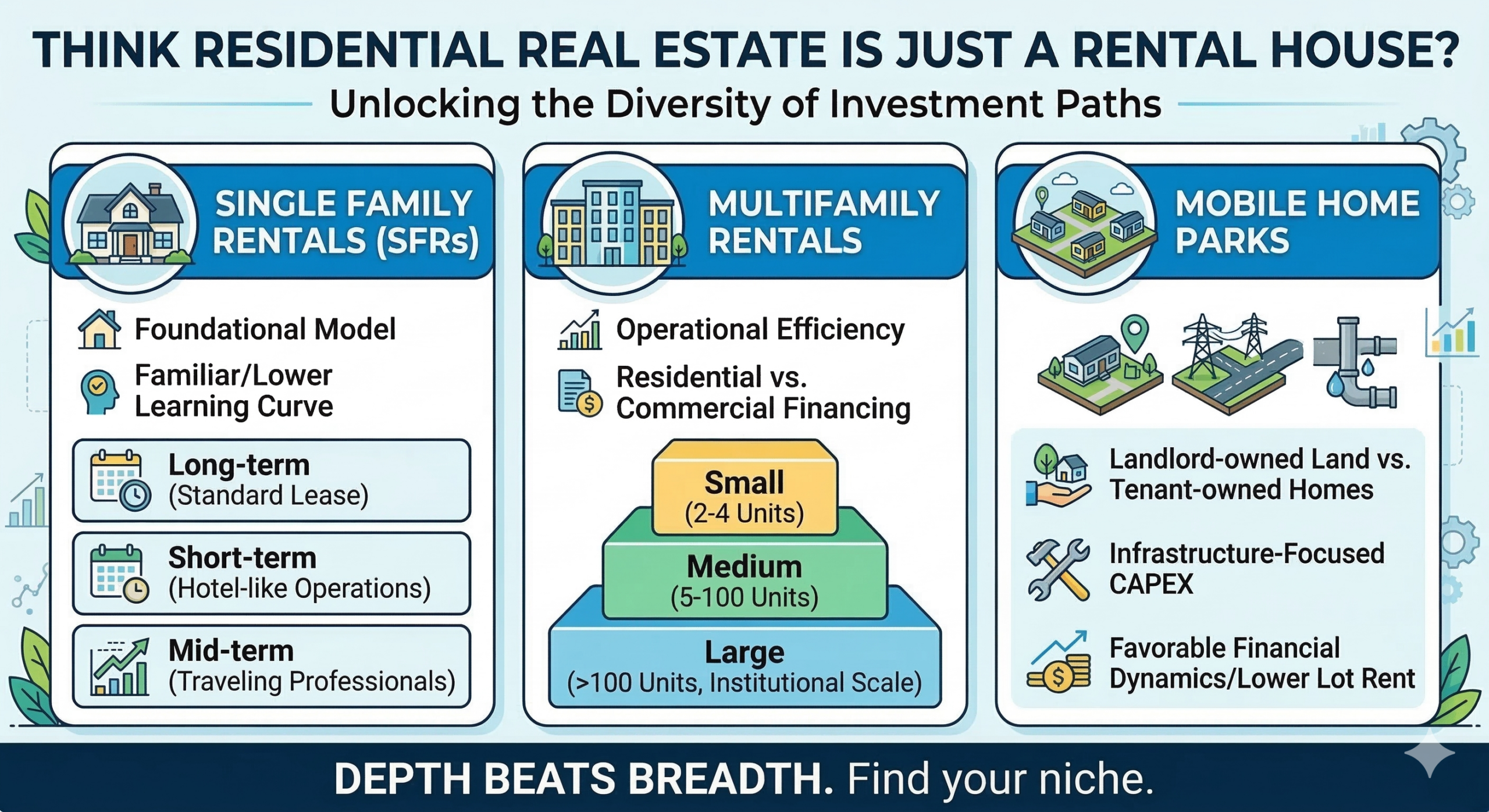
This article discusses the residential asset class, which spans three broad investment categories: single family rentals, multifamily properties, and mobile home parks. Within those categories sit distinct strategies that carry different risk profiles, management demands, and return characteristics.
The next two articles will cover commercial asset classes and the cross cutting strategies that can be applied to most asset classes.
Residential Asset Classes
Single Family Rentals (SFRs)
Single family rentals are where most investors begin, and for good reason. Single family houses are familiar. You live in one. You understand the basics of what makes a house livable, what deferred maintenance looks like, and what a reasonable neighborhood feels like to walk through. That familiarity lowers the learning curve considerably. Within the single family category, three distinct strategies exist.
Long-term rentals are the foundational model. You acquire a property, lease it to a tenant who will occupy it as a primary residence, and collect monthly rent. The unit is typically unfurnished, though furnished arrangements exist. Utilities may or may not be included depending on how you structure the lease. You are bound by local landlord-tenant laws, which govern everything from security deposits to eviction procedures. Day-to-day management can be handled personally or delegated to a professional property manager. These decisions directly impact both the amount of time you need to invest and your monthly cash flow.
Short-term rentals represent a fundamentally different business. The average stay runs a week or less. Your guests are travelers, not residents, which means you are operating something closer to a hotel than a traditional rental. Landlord-tenant law generally does not apply. The operational demands are substantially higher. Units must be furnished and stocked. Cleaning, turnover, and guest communication occur repeatedly throughout each month. Property managers who specialize in this space exist, but their fees reflect the additional work involved and as a result are typically well above rates charged for long-term rental management.
Mid-term rentals occupy the space between these two models. The target tenant is usually a traveling professional such as a consultant on a multi-month engagement, a nurse on a contract placement, or a relocating employee waiting on a home purchase. Stays generally run one to six months. Units are furnished. Utilities are typically kept in the landlord’s name to avoid turnover complications with utility providers. Whether mid-term rentals fall under local landlord-tenant law depends on stay duration and jurisdiction. Specialized property managers exist for this niche (e.g. some focus specifically on placing traveling healthcare professionals) and their fees reflect the additional services they provide, such as employment verification and utility management.
Multifamily Rentals
Small multifamily properties, duplexes, triplexes, and fourplexes, are the next natural step for investors building out from single family rentals. Residential financing applies to these properties, meaning you can obtain the same mortgage products available for a primary residence or single family investment. The management dynamics are familiar. The primary difference is that multiple units occupy a single location, which offers some operational efficiency.
Properties with five to one hundred units occupy different financial and operational territory. Commercial financing is required, which typically carries higher rates, shorter terms, and balloon structures rather than full amortization. Finding the right property manager for this size range can be challenging: the portfolio is too small to justify a dedicated on-site manager, yet it demands more active engagement than a firm focused on single family properties will typically provide. The properties are also too small to attract the large institutional operators who focus on scale. This gap creates an opportunity for mid-sized operators who build sufficient portfolio concentration to support a dedicated management team across several properties.
Properties exceeding one hundred units typically support on-site management staff, and often include maintenance, leasing, and administrative teams. The fixed overhead that once represented a burden becomes an efficiency at this scale. Properties of this size are rarely held by individual investors. They are typically owned through partnerships, which is where syndications enter the picture for passive investors.
Mobile Home Parks
Mobile home parks follow a fundamentally different ownership model than other residential categories, and that difference shapes both the risk profile and the management demands.
In most mobile home parks, tenants own their homes. You own the land beneath them. Your income comes from lot rent rather than from the structures themselves. Because tenants own their homes, maintenance and repair of the units falls to them. Your capital expenditure exposure is largely limited to the infrastructure: roads, utility connections, and common areas. Depending on the property, there may be additional infrastructure that carries its own operation complexity and cost such as sewage treatment systems, water supply, parks, and community facilities.
The financial dynamics of this model can be favorable. Because you are renting land rather than a complete housing unit, lot rents are typically lower than apartment rents in comparable markets. However, expenses are correspondingly lower and the absence of unit-level maintenance can improve net operating income.
The legal framework governing mobile home parks differs from standard landlord-tenant law in most jurisdictions. This distinction exists for a practical reason: moving a mobile home is a significant undertaking, far more complex and costly than relocating the contents of an apartment. The regulatory protections tenants receive reflect that reality. Investors entering this asset class should develop a working understanding of the applicable regulations in their target markets before acquiring a property.
Summary
Residential real estate covers substantial ground, and that variety is by design. Different asset classes serve different investor profiles, different market conditions, and different stages of a portfolio’s development.
The residential categories covered here, however, represent only part of the picture. Commercial real estate — office, industrial, retail, self-storage, and land — carries its own opportunities and risk characteristics, many of which align well with passive investment strategies. The next article examines those asset classes, followed by an article on cross cutting strategies that can be applied against all of these asset classes. Understanding the full landscape before narrowing your focus is worth the effort.
PS: Are you an adventurer at heart? Always wanted to hang out with thousands of penguins in their natural environment and visit the frozen continent? Join me and a small group of real estate investors for an exclusive workshop aboard an expedition cruise to Antarctica in February 2027. Build lifelong relationships while exploring one of Earth’s last pristine wildernesses. To learn more and reserve your cabin go to https://www.mbc-rei.com/2027 Have questions? Email me at events@mbc-rei.com.
The complete set of newsletter archives are available at:
https://www.mbc-rei.com/mbc-thoughts-on-passive-investing/
This article is my opinion only, it is not legal, tax, or financial advice. Always do your own research and due diligence. Always consult your lawyer for legal advice, CPA for tax advice, and financial advisor for financial advice.