
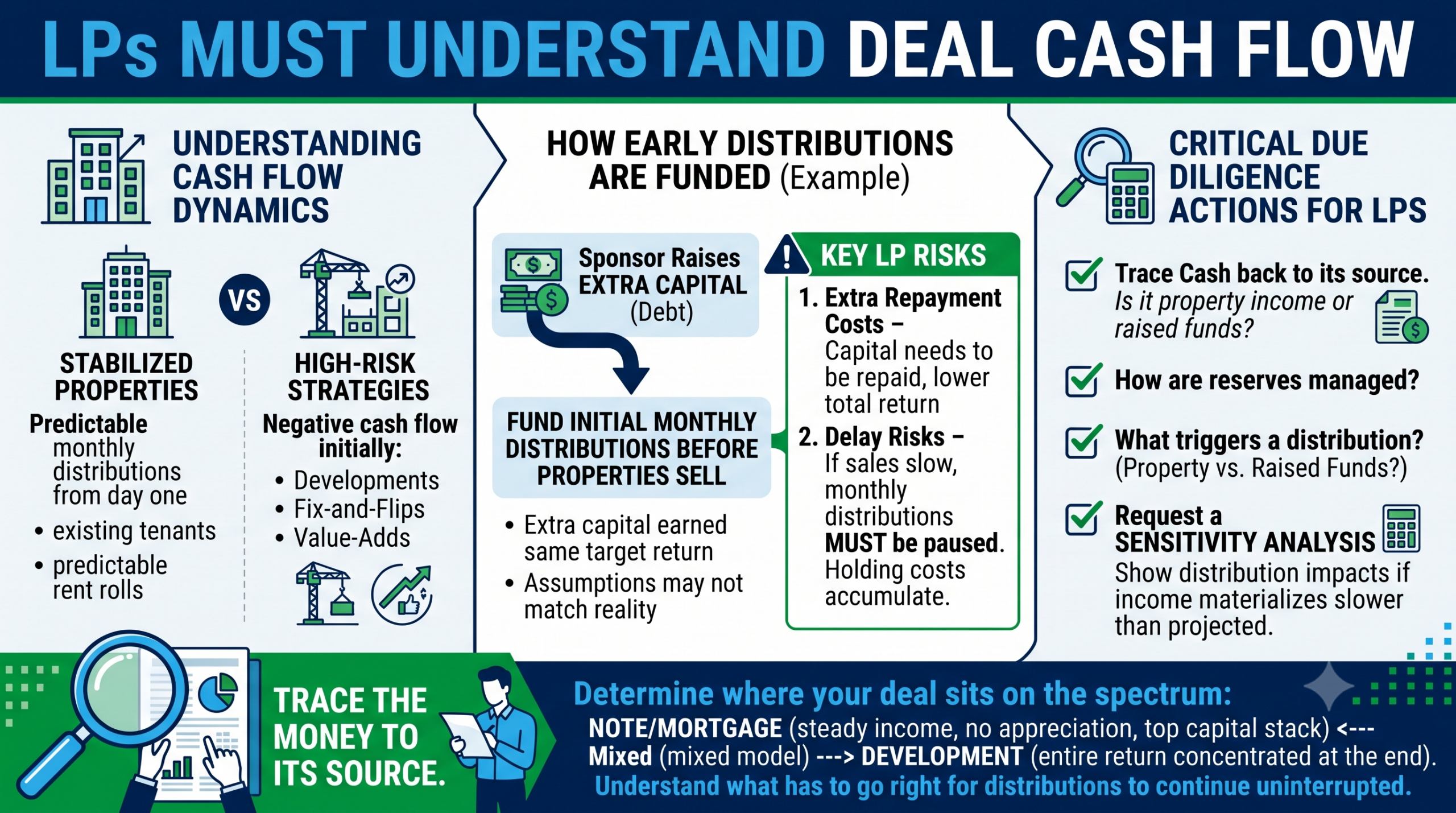
Most LPs assume that when a sponsor promises monthly distributions, the property already generates enough income to cover those payments. This assumption holds true for certain deals such as stabilized properties with existing tenants and predictable rent rolls. However, for development projects, fix and flip strategies, and heavy value add opportunities, that assumption often does not match reality.
As a limited partner, you do not manage the project day to day. That responsibility belongs to the sponsor. Your responsibility is to understand the deal well enough to recognize the risks you are accepting when you invest your capital.
How Income and Expense Timing Shapes Deal Risk
One of the most important questions to ask before investing in any deal is how income and expenses align over time, and what happens if income arrives slower than projected. Every investor wants income to exceed expenses from day one. For certain deal types, that outcome is not possible, and understanding why separates informed investors from investors who are simply hoping for the best.
Development deals, fix and flip projects, and value add opportunities typically produce negative cash flow in the early stages. Renovation costs, holding costs, and financing costs accumulate before the property generates enough revenue to offset them. When you evaluate a deal like this, you need to identify which expenses are fixed, which are variable, and what the sponsor plans to do if income grows slower than projected. You also need to understand where your payments fall in the priority list. Hint: as an equity investor, you are paid last.
How Cash Flow Impacts a Deal
A friend of mine recently described a deal that had to pause distributions because the project was not progressing as planned. The pause was disappointing, but it should not have come as a complete surprise given how the deal was structured.
The deal effectively involved a series of fix and flip properties. The sponsor purchased the properties, refurbished them, and sold them to owner occupants over time. This model is well understood in real estate and the deal could be structured several different ways. In this case, the sponsor structured the deal so investors received monthly cash flow starting early in the project, well before any properties sold. From the investor perspective, the arrangement resembled holding a mortgage on the property which was extremely appealing. In practice, the investors were equity partners, not lenders.
The issue with this structure is that the deal does not generate steady cash flow. The company generates income only when a property sells. If a property does not sell on schedule, there is no revenue from that asset to fund the monthly payments investors expect. Meanwhile, holding costs and other expenses continue accumulating, and those obligations come due before investors see any returns.
To generate early distributions, the sponsor raised more capital from investors than the deal strictly required to fund the renovations and acquisitions. The extra capital funded the initial monthly distributions. The underlying expectation was that once properties began selling, the resulting cash flow would replace those early payments and carry the deal forward on its own.
Two Risks Investors Should Have Caught
There is nothing inherently wrong with this approach, but there are two potential risks that investors should have seen as part of their due diligence
- The extra capital also needs to be repaid. Because the sponsor raised more money than the deal needed to fund the purchases and renovations, the sponsor owes investors more in total than if the raise had matched the minimum required amount. The capital used to fund early distributions earned the same target return as the capital that funded the properties themselves. Investors who received early monthly payments may end up with a lower total return than they would have received by waiting for the properties to sell and taking a single, larger distribution later. The monthly check feels reassuring, but it comes at a cost that is easy to overlook.
- What happens if sales are slower than projected. Since the deal depends on property sales for its income, any delay in selling forces the sponsor to pause distributions. The properties are not generating revenue, and there is no other source of cash to cover the payments investors expect. Depending on how the sponsor manages reserves, a sustained sales delay can affect the health of the deal itself, not only the timing of investor returns.
From my perspective on the outside, the second risk appears to be what happened in his case. The market where the properties are located is currently experiencing a downturn, and sales are running well behind the sponsor’s original projections. The sponsor is managing the situation as best as possible, but broader market conditions sit outside anyone’s direct control.
Questions Worth Asking Before You Invest
Before committing capital to a deal that pays monthly distributions from day one, make sure you understand where that cash is coming from. Is it coming from property itself or from raised funds. Ask how the sponsor manages reserves and what triggers a pause in distributions if the project falls behind schedule.
If you are unsure about the stability of the deal, request a sensitivity analysis as part of your due diligence. A sponsor should be able to show you what happens to distributions if income doesn’t materialize as expected.
What This Means for Your Own Due Diligence
The outcome of this specific deal remains uncertain. Sales may recover, and the sponsor may work through the backlog successfully over the coming months. More importantly, the lesson here applies across nearly every type of investment you will evaluate as a limited partner, not only fix and flip deals.
Before you invest, understand where the deal sits on the spectrum between cash flow and appreciation. A note or mortgage investment produces steady income with no appreciation built in, but places you at the top of the capital stack. A development project produces no cash flow until the properties sell, with the entire return concentrated at the end of the hold period. Many real deals, including the one described here, sit somewhere between these two models. Understanding exactly where your deal falls on that spectrum tells you what has to go right for your distributions to continue without interruption.
Remember that a sponsor’s projections represent informed estimates, not guarantees. Even a well intentioned and competently executed deal remains subject to market forces outside the sponsor’s control. As an investor, you accept risk with your capital every time you invest. No investment removes risk entirely. Understanding the risk you are taking, and confirming you are being compensated fairly for it, remains your responsibility as a limited partner from the day you sign the subscription documents.
Understanding how a deal generates its distributions represents one of the most important due diligence steps a limited partner can take before committing capital.
When you review a new opportunity, trace the money back to its source. Confirm where any early distributions come from and make sure you are aligned with that strategy.
Every deal carries risk, and every informed investor accepts that risk with open eyes and ensures they are compensated appropriately for the risks being taken.
PS: I am building a free discord community of investors who enjoy adventure travel. If you are looking for a place to share travel tips, get feedback on investment options, and hang out with interesting people, let me know and I will send you an invitation.
The complete set of newsletter archives are available at:
https://www.mbc-rei.com/mbc-thoughts-on-passive-investing/
This article is my opinion only, it is not legal, tax, or financial advice. Always do your own research and due diligence. Always consult your lawyer for legal advice, CPA for tax advice, and financial advisor for financial advice.