

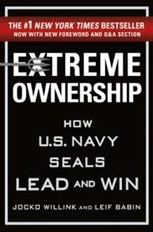
I recently re-read Extreme Ownership by by Jocko Willink and Leif Babin as part of the Money Mental Book Club. I liked it even better the second time.
The core thesis of the book is simple to state and difficult to practice. To succeed, a person must take complete ownership of their current situation, treat every outcome as their responsibility, and decide how to move forward from there. This requires a realistic assessment of where a person stands, without assigning blame to a market, a partner, or bad luck.
Each chapter follows the same pattern. It opens with a real combat story from the authors’ time as Navy SEALs, moves into the leadership concept behind that story, and closes with an application to business. I expected the business sections to carry the most weight. Instead, the combat stories provided the most insight into the practical application of the concept. They put the pressure of a typical business decision into perspective against decisions made under direct threat to life.
The book divides into three sections: establishing the right mindset, the four rules that govern the approach, and the discipline required to sustain it over time.
Winning the War Within
The first section restates the central idea of the book with force. A leader owns everything that happens within their area of responsibility, even situations they were not directly involved in. This requires clear communication of goals, clear standards, and consistent enforcement of those standards.
None of this works without belief in the mission. A leader who does not believe in an assignment must ask questions until they understand the reasoning behind it. Only then can they communicate that reasoning to a team in a way the team can act on.
This concept applies directly to passive investing. When a deal underperforms, the instinct is to point to the sponsor, the market, or the broader economy. Extreme ownership asks a different set of questions. Did you evaluate the sponsor thoroughly before committing capital? Did you understand the assumptions behind the projections you invested against? Did you accept a level of risk that matched your actual risk tolerance, or a level that only looked acceptable in hindsight? Taking ownership of an investment decision, including a decision that goes wrong, builds the judgment needed to make better decisions on the next opportunity.
The Laws of Combat
The second section outlines four rules that support extreme ownership in practice.
“Cover and Move” describes how teams support each other. The authors point out that teams want to help each other, but that instinct requires coordination to function. One team cannot know how to help another team without direct communication. For an investor, this rule points to the value of a network of other investors who share information about sponsors, markets, and deal structures. That support does not appear automatically. It requires investors to build and maintain those relationships over time, well before a specific deal requires a second opinion.
“Simple” is a reminder that complicated plans tend to fail. A plan built to account for every possible contingency collapses the moment something unplanned occurs. The authors recommend a simple plan built around a clearly communicated goal, with the expectation that the team will work through unexpected problems as long as they understand the objective. For an investor, this supports looking at deals that can be clearly explained, without a set of complicated conditions. An investment dependent upon too many variables is unlikely to succeed. Similarly, an investment thesis should be clear and simple enough to quickly reject the majority of opportunities you are presented to.
“Prioritize and Execute” requires a team to identify the single most pressing issue, decide on an action, take that action, then reassess. This becomes difficult when several problems demand attention at once, but the authors argue that failing to prioritize leads to mistakes across the board. In due diligence, this means resisting the urge to evaluate every factor with equal weight at the same time. A sponsor’s track record, the debt structure, and the local market fundamentals all matter, but they do not all require equal attention from the start. Working through them in order, rather than all at once, produces a more thorough review.
“Decentralized Command” ties the other three rules together. A leader cannot track every detail across a team and must trust that team members have what they need to make sound decisions. This requires the leader to communicate intent clearly and to define the boundaries of each person’s authority: what decisions they can make on their own, what decisions require approval, and what information needs to reach the leader without being asked for. Within your investment team, you need to provide clear guidance to your team (e.g. CPA, estate planning attorney, syndication lawyer, due diligence expert, etc.) about your goals and the role you expect each team member to play and how they should coordinate. Your role is to establish trust across these teams so that they can operate effectively together.
Sustaining Victory
The final section addresses how to maintain a culture of ownership over time. It covers the value of reviewing past decisions honestly to identify what worked and what did not, along with the importance of managing the relationship with those above you in an organization.
The chapter titled Discipline Equals Freedom stood out on this reading. The authors argue that the discipline to prepare in advance creates the freedom to respond effectively when a situation changes. They use the example of physical conditioning, which made it possible to handle demanding physical tasks, such as carrying a full pack through desert heat, without that task becoming the limiting factor in the mission. The same principle applies to building an investment portfolio. The discipline to save consistently, evaluate sponsors thoroughly, and diversify across asset types before a downturn arrives creates the freedom to remain calm and make sound decisions when conditions change. Investors who skip this preparation face far fewer options when the situation actually changes.
Summary
Extreme ownership represents a discipline that applies well beyond a military unit. It requires a willingness to look at a difficult outcome, including an investment that did not perform as expected, and ask what you might have done differently, rather than looking for someone else to hold accountable.
The best investors I know share this trait. They review their own decisions honestly, including the ones that lost money, and use that review to sharpen their process for the next opportunity.
Ownership of your decisions is the starting point for ownership of your financial future.
The complete set of newsletter archives are available at:
https://www.mbc-rei.com/mbc-thoughts-on-passive-investing/
This article is my opinion only, it is not legal, tax, or financial advice. Always do your own research and due diligence. Always consult your lawyer for legal advice, CPA for tax advice, and financial advisor for financial advice.