
Breaking your paycheck dependency (BYPD) can seem like a daunting task. You have defined your investment thesis and know what you want to accomplish. The people you surround yourself with will determine how quickly you get there. That is why the next step is finding the right room: a group of people who have already done what you want to do, but who are still close enough to your own stage that you can relate to them and learn from how they got there.
If you want to invest actively, look for people who already own two to ten rental doors. If you want to invest passively, look for people who have made one to fifteen syndication investments. Meeting people just a little ahead of you on this path eases the uncertainty you may feel right now and it speeds up your own progress, since you now have a network to lean on when you get stuck.
Books and Podcasts
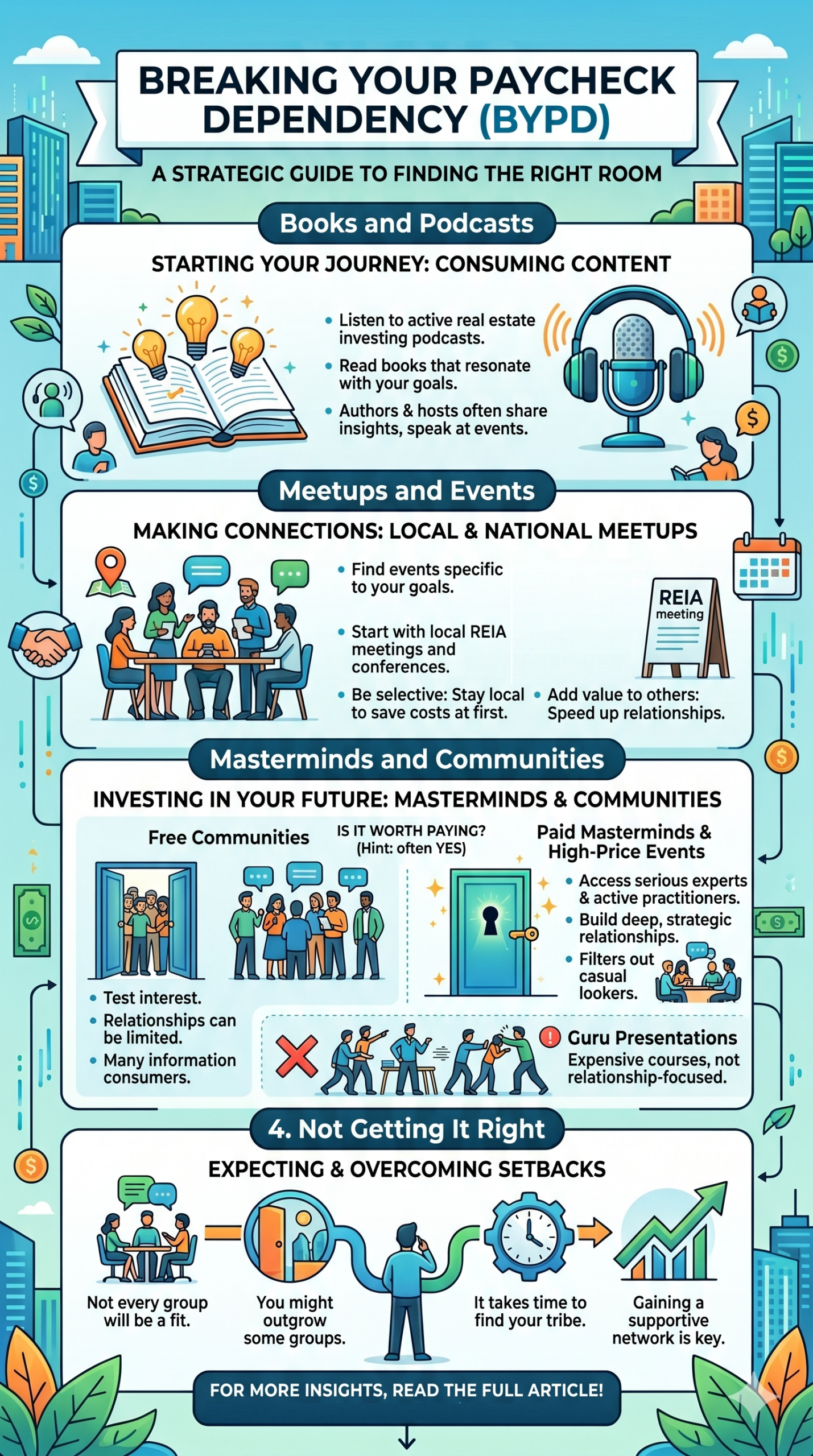
Books and podcasts are a good place to start. There is a podcast covering nearly every corner of real estate investing, so look for ones that are still active, that resonate with you, and that match where you are and where you are heading. The author or host will often share insights you can use directly, and many also speak at industry events or host events of their own. If you find an event that several people you already follow plan to attend, it is likely worth attending yourself.
Meetups and Events
A meetup or event built around your specific situation and goals is exactly the kind of room you want to be in. Events vary widely, both in focus and in price, so be selective about which ones you attend. If you are just starting out and are not sure what to look for, begin with events near you. This could be as simple as attending your local REIA (real estate investing association) meetings, where you will likely find a number of local, active investors. You may also find that your city hosts a regional or even national conference. Staying local keeps your travel costs down while you figure out exactly what you need. Once you have a clearer sense of your goals, or if nothing relevant exists nearby, you will likely need to travel to reach the most useful meetings. I generally attend two or three events each year, though I have gone to as many as five in years when I was looking at a broad range of investments.
As you attend the same events over time, you get to know people better, and they get to know you. This is when the magic happens. Stay consistent, become a regular, remember who you talk to, and you will naturally build your own tribe within that community. One way to speed this up is to add value to people you find interesting. This could be as simple as sharing notes, having a thoughtful conversation about their presentation, or saving them a seat at lunch. It could also mean helping a vendor set up or tear down their booth, or passing out handouts for someone who is presenting.
Masterminds and Communities
In many cases, it is worth paying your way into the right room.
Low cost events tend to draw people who are curious about a topic, while active practitioners and serious experts are harder to find. Free communities follow a similar pattern: many members consume information without engaging much in the conversation. These groups still serve a purpose. They are a good way to test a community before committing. I have gotten real value from them personally. The relationships you build there, however, tend to be limited unless you are strategic about who you approach and how you engage them.
Paid mastermind communities and high price events work differently. The cost filters out casual lookers and, when the group is run well, gives you access to people who are serious about reaching their goals. These groups make it easier to build the kind of relationships that move you forward. I have spent tens of thousands of dollars on small events and masterminds over the years and gotten real value from them. One of the best is a small retreat that costs around $12k for two people for a week. I do not attend every year, but whenever I do, I find it extremely insightful.
Even so, be careful about which groups you join. I do not recommend the “run-to-the-back-of-the-room” offers pitched at the end of guru presentations. These rarely get you into the right room. They are usually expensive courses that put you in an environment built to sell you something else. A few may be worthwhile, but most do little to help you build relationships, which is exactly what you need at this stage.
Not getting it right the first time
As you look at different events and masterminds, do not expect to be wowed by every event you attend. In many cases, you will not resonate with the people in a group, even when you share the same stated goals. In other cases, you will find that you have already outgrown a group and are not able to learn much more from them. It is normal to take a while before you find a group that truly fits.
Once you do, and your tribe takes shape, you gain a group of people you can learn from. Building inside a community is more rewarding, and more efficient, than building alone. A network that can support you when you get stuck is a real step toward breaking your paycheck dependency.
PS: I am building a free discord community of investors who enjoy adventure travel. If you are looking for a place to share travel tips, get feedback on investment options, and hang out with interesting people, let me know and I will send you an invitation.
The complete set of newsletter archives are available at:
https://www.mbc-rei.com/mbc-thoughts-on-passive-investing/
This article is my opinion only, it is not legal, tax, or financial advice. Always do your own research and due diligence. Always consult your lawyer for legal advice, CPA for tax advice, and financial advisor for financial advice.