

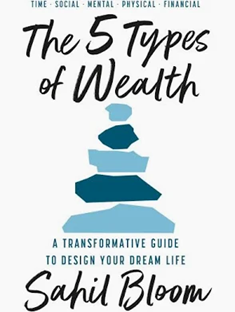
Most personal finance books operate from the unspoken assumption that financial wealth is the only kind worth building. They teach you to optimize your portfolio, minimize your tax burden, and compound your returns — useful tools, all of them. What they rarely ask is whether financial wealth can deliver the life you are trying to build. Sahil Bloom’s The 5 Types of Wealth: A Transformative Guide to Design Your Dream Life is a direct challenge to that assumption. It is not an investing book. But for anyone seriously thinking about why they are building wealth in the first place, it is worth reading.
The Core Argument
Bloom opens with a concept he calls the arrival fallacy: the false assumption that reaching a particular achievement or goal will create durable feelings of satisfaction and contentment. He describes his own experience of exclusive money-pursuit as something that was “slowly, methodically robbing me of a fulfilling life.” The realization that followed was not that money is unimportant as he is careful to acknowledge that money is important. The insight was more precise: “I wasn’t playing the wrong game, I was playing the game wrong.”
From that pivot, Bloom builds a framework around five distinct types of wealth:
- Time Wealth: Awareness of time’s finite nature, and the freedom to direct your attention toward what matters most
- Social Wealth: The depth and quality of your connections to the people who matter most in your life
- Mental Wealth: Clarity of purpose, a hunger for growth, and the creation of stillness to think clearly
- Physical Wealth: The daily movement, nutrition, and recovery practices that sustain a vital, long life
- Financial Wealth: Income generation, expense management, and long-term investment as the enabler of the others, not the end goal
The framing is not entirely unique but what makes the book worth reading is how Bloom discusses each type. It is a practical guide including personal reflection on decisions he has made.
I got the most from the Time wealth and Financial wealth sections. The Social, Mental, and Physical Wealth sections were are also good, though they resonated less personally with me.
Time Wealth
In my opinion, the section on Time Wealth is where the book stands out. Bloom introduces a deceptively simple exercise: take a person you love deeply but do not see enough. Estimate how many times per year you see them. Subtract their age from eighty. Multiply those two numbers. The result is the approximate number of times you will see that person before they are gone.
The math is terrifying. It takes an abstract awareness of the finite nature of time and makes it visceral and immediate. As Bloom puts it, “despite not being at the end of your life, you may very well be nearing the end of your time with some of the most important people in your life.”
He distinguishes between two Greek concepts for time: chronos, the sequential and quantitative flow of equal time units, and kairos, the idea that certain moments carry more weight than others. This leads to the insight that busyness and scattered attention are not the result of having too much to do but rather are the cause of losing control over time in the first place.
Bloom’s three pillars of Time Wealth — awareness of time’s impermanence, the ability to direct concentrated attention to what matters, and the freedom to own how you spend your hours — form the practical foundation of the section. His twelve systems for building Time Wealth range from the Eisenhower Matrix and Parkinson’s Law to the Art of No and a framework for the four types of professional time. Readers familiar with productivity literature will recognize many of these tools. What stands out here is the context. Specifically that these are not efficiency hacks, they are mechanisms for protecting the irreplaceable.
Financial Wealth
The Financial Wealth chapter is the one most directly relevant to most people, and Bloom handles it with appropriate care. His framing centers on a Swedish concept called lagom — “just the right amount.” The chase for more is culturally celebrated, he argues, while contentment with enough is easily misread as a lack of ambition. His counter is direct: “Never let the quest for more distract you from the beauty of enough.”
This is not an argument for settling. Bloom is explicit that the “Enough Life” can be as ambitious or as lavish as you choose to define it. The point is to define it. “Your aim then becomes building Financial Wealth — through income generation, expense management, and long-term investment — up to the point where it enables that Enough Life that you have defined.”
The concept of what is enough should be familiar to anyone who has thought seriously about breaking their paycheck dependency. Financial wealth is the enabler. It creates the conditions under which the other four types of wealth become accessible. It is not, however, the scoreboard. “Money solves money problems, but it will not, in a vacuum, solve anything else.”
Social Wealth
Social Wealth is defined as the depth and quality of connection to the people who matter most in your life. Bloom anchors this section with one of the longest longitudinal studies on human health and happiness, which reached the straightforward conclusion that relationships are, quite literally, everything. Strong, healthy relationships were the best predictor of life satisfaction far outpacing wealth, fame, IQ, and genetics. Perhaps the most striking finding was that the single greatest predictor of physical health at age eighty was relationship satisfaction at age fifty.
Bloom builds Social Wealth across three pillars. The first two are relatively well known: depth of connection with a small circle of close relationships and breadth of connection to a larger community. The third, earned status, is less recognized and represents the genuine respect and trust of your peers built through demonstrated character. In particular, he draws a sharp line between the allure of status symbols, which offer the imagination of respect, and earned status, which delivers the real thing. His framework for categorizing relationships by support level and interaction frequency helps identify which connections deserve more deliberate investment. He also introduces the concept of “doorknob” questions, which are statements or questions that invite the other person to open a door and walk through rather than simply answer and stop, as a tool for having better conversations.
Mental Wealth
Mental Wealth is built across three pillars Bloom identifies as purpose, growth, and space. Purpose is the clarity of a personal vision, which does not need to be grand or important to anyone else but is simply yours. Growth is the desire to improve, grounded in a mindset that treats intelligence and character as dynamic rather than fixed. Space is the deliberate creation of stillness. The ability to slow down, think clearly, and listen to your own inner voice rather than simply reacting.
Bloom argues that those who adopt a growth mindset face life’s inevitable challenges with resilience precisely because they have avoided tying their identity too closely to any single outcome. They ground their sense of self in effort, energy, and improvement rather than in results alone.
The space pillar may ultimately be the most important for long term success. The basic argument that most asymmetric opportunities require creative, nonlinear thinking that simply cannot happen in a state of constant busyness is both obvious and hard to achieve. His practical recommendation is simply to protect time for ideation and consumption as deliberately as you protect time for creation and management.
His framework for Socratic questioning is particularly valuable for high-stakes decisions where the cost of asking the wrong question is as significant as the cost of finding the wrong answer. The purpose of this process is to identify the right problem before attempting to solve it, challenging the assumptions underlying your beliefs, and evaluating the evidence. By spending energy up front to ensure you are solving the right problem, you ultimately get to the best solution faster and easier than others who try the most obvious solutions first.
Physical Wealth
Physical Wealth is the most straightforward type of wealth. He defines it across three controllable pillars: daily movement through cardiovascular exercise and resistance training, nutrition centered on whole and unprocessed foods, and recovery anchored by consistent, high-quality sleep. His broad point is that most results in health and longevity are driven by a small number of simple inputs, and that complexity in the wellness industry typically reflects commercial incentives rather than scientific necessity.
What elevates this section beyond a standard health overview is Bloom’s framing of Physical Wealth as a catalyst rather than a category. He argues that the discipline of building physical health initiates a mindset shift that creates ripple effects across every other area of life. Physical Wealth is not just about living longer. It is about maintaining the energy, clarity, and presence to actually show up for the other four types of wealth while you have the chance.
Who Should Read This
The 5 Types of Wealth is most valuable for people who have been playing the financial game well but have a nagging sense that something important is missing. The book will sharpen your answer to the fundamental question what am I actually building toward?
Bloom’s central message that a wealthy life may be enabled by money but will ultimately be defined by everything else is worth sitting with.
His goal is for you to build your life with intention, thoughtfully balancing the five types of wealth to establish an “Enough Life” that encompasses your dreams.
That is, in my opinion, the only version of financial freedom that is worth the work.
PS: Are you an adventurer at heart? Always wanted to hang out with thousands of penguins in their natural environment and visit the frozen continent? Join me and a small group of real estate investors for an exclusive workshop aboard an expedition cruise to Antarctica in February 2027. Build lifelong relationships while exploring one of Earth’s last pristine wildernesses. To learn more and reserve your cabin go to https://www.mbc-rei.com/2027 Have questions? Email me at events@mbc-rei.com.
The complete set of newsletter archives are available at:
https://www.mbc-rei.com/mbc-thoughts-on-passive-investing/
This article is my opinion only, it is not legal, tax, or financial advice. Always do your own research and due diligence. Always consult your lawyer for legal advice, CPA for tax advice, and financial advisor for financial advice.