

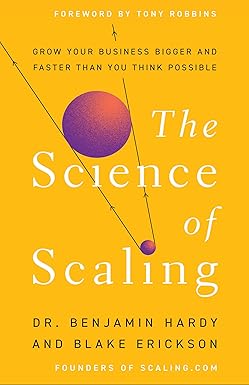
The Science of Scaling by Benjamin Hardy and Blake Erickson offers a compelling framework for entrepreneurs who want to scale their businesses but struggle to identify the path forward. While written primarily for business owners, the core principles apply to building an investment portfolio capable of generating the passive income needed to break paycheck dependency. Whether you are scaling a business or scaling your path to financial freedom, the challenge remains the same: you need a clear vision, ruthless prioritization, and aggressive timelines.
This book serves as an excellent follow-up to 10X is Easier Than 2X, which Ben Hardy wrote with Dan Sullivan. The central premise holds that by clearly articulating an important goal you do not currently know how to meet (setting your Frame), eliminating everything not directly related to that goal (raising the Floor), and setting extremely tight timelines (accelerating your Focus), you can accomplish more than you believe possible.
For passive investors, this could translate into setting ambitious cash flow targets, eliminating investment activities that require active participation, and using deadlines to force action.
The three-part framework provides a practical system for anyone with big goals they are not reaching.
Setting Your Frame
The premise of setting your frame is to establish a goal so ambitious that you do not currently know how to accomplish it. If your goal represents something you already know how to achieve, it may produce linear growth but not the 10x scaling the authors describe. The first critical principle is commitment. You may not know how you will accomplish the goal, but you commit to doing whatever it takes to reach it.
This commitment matters because it forces exploration of options outside your normal path. You must consider all potential ways to accomplish the goal. Brainstorming this generates multiple potential paths, which can then be narrowed to a small number of approaches that will actually allow you to reach your target. If numerous ways exist to reach your goal, you likely have not set it high enough.
For investors building passive income, this means setting a cash flow target that seems impossible with your current strategy. Perhaps you aim to generate $10,000 per month in passive income within two years when you currently generate none. This forces you to explore investment vehicles and partnership structures you might otherwise never consider. The goal must be large enough that your current approach cannot possibly achieve it.
A key component of setting an impossible goal involves providing a timeline shorter than you believe possible. Long timelines allow you to delay making changes and identifying the critical paths to accomplishing the goal. By shortening the timeframe, you gain clarity on the critical path sooner and take action sooner.
Consider an example. If your plan requires acquiring 100 rental units in five years and you currently own none, you do not necessarily need to change what you are doing today. Perhaps you review a market or two, take a class in a couple of months, or attend a conference next quarter. These activities feel productive but lack urgency.
If your goal requires 100 units in nine months, you must start taking action immediately. You need that market identified, financing options explored, and broker relationships established this week. You need to be evaluating deals within 30 days. The compressed timeline eliminates the luxury of preparation and forces immediate engagement with the actual work of acquisition.
This principle applies whether you are building a business or a portfolio. The shortened time horizon creates the pressure needed to identify and execute on the critical path rather than engaging in peripheral activities that feel productive but do not drive results.
Raising Your Floor
The second major principle from the book emphasizes the importance of simplifying your environment. The goal you set should be ambitious enough that you cannot take on other tasks or activities that do not directly contribute to meeting it. Attempting to do so would prevent you from reaching the goal. You must simplify both the tasks you undertake and the processes you use for those tasks so that everything you do contributes to that goal.
To be clear, this does not mean you cannot have other goals in different parts of your life. You can maintain separate business goals, health goals, and relationship goals. The goals you are using to drive rapid growth, though, need to be sufficiently focused that you can use them as a filter for all activities and opportunities.
The ability to focus exclusively on tasks that directly impact your goals is difficult. Many people want to take on synergistic tasks related to their goal but not on the critical path to achieving it. This represents a critical mistake because it diverts energy away from meeting your goal. If your goal is sufficiently ambitious, this diversion means you will not meet it.
For passive investors, this often manifests as analysis paralysis or endless education. You attend conferences, read books, join masterminds, and build relationships. These activities feel productive and relevant. If none of them lead to capital deployment in cash-flowing assets, though, they do not advance your goal of breaking paycheck dependency. The conference that does not result in identifying a sponsor you will invest with is a distraction. The book that does not change your investment thesis or lead to a specific action is entertainment, not progress.
Focusing exclusively on your goal requires saying no to all tasks not directly related to it, including synergistic activities. If the task is not on the direct path to meeting your goal, it gets dropped. In some cases, you may need to delegate the task to someone else. Paying bills cannot be dropped because you have other obligations, but it does not require your personal attention if someone else can handle it more efficiently.
Saying no inherently means disappointing people, which can be extremely difficult. It can even mean dropping existing, profitable parts of your business and firing customers so that you can focus and meet your scaling goals. As Ben Hardy states: “Until you are willing to take a hard look at everything you are currently saying yes to and remove everything stopping you from being accountable to the new goal, you are lying to yourself.”
This step is uncomfortable and will not be popular with everyone involved. For investors, this might mean exiting smaller investments that require disproportionate attention, declining syndication opportunities that do not fit your investment thesis, or ending advisory relationships that provide general education but not measurable progress towards your goal.
Providing transparency into your decision-making process increases both trust and the likelihood you will accomplish your goals. When you clearly articulate what you are focusing on, why it is critical for meeting your goal, and why you cannot take on other tasks, people understand your choices even when those choices disappoint them.
By focusing exclusively on tasks that contribute directly to your goal, you increase your accountability to meeting it. This clarity also helps you identify when you are deviating from the path and allows you to course-correct before significant time and resources are wasted.
Accelerate Your Focus
Setting and meeting impossible goals requires work. You need extreme discipline to identify the paths that will allow you to accomplish the goal and filter out everything else. Determining what will enable you to reach your goals can be time-consuming and frustrating. The successful path is rarely obvious, so you will spend time exploring options that do not pan out. This is expected. The key is abandoning those paths quickly when you determine they are not contributing to your goal rather than persisting with them out of momentum or sunk cost fallacy.
For passive investors, this means conducting thorough due diligence on sponsors and deals but making decisions within a defined timeframe. If a sponsor does not meet your criteria after initial evaluation, you move on rather than conducting additional research hoping they will eventually qualify. If a market shows fundamental weaknesses during your analysis, you eliminate it from consideration rather than searching for evidence that your concerns might be overblown.
In order to scale, you need to build a business that does not rely on you to be involved in every decision. If you are involved in every choice, you will always be a bottleneck. This principle applies equally to investment portfolios. If you must personally evaluate every aspect of every deal, you will never achieve the scale needed to generate significant passive income without building an entire business around it. This is why identifying trustworthy sponsors and establishing a clear investment thesis matters. These systems allow you to make quality decisions efficiently rather than becoming the limiting factor in your own growth.
The authors make an important point that highly talented people prefer working on high-impact projects. They also prefer working with other high performers rather than average employees. As you build your team, you must decide whether you want to hire high performers. If so, you need to manage them appropriately: giving them freedom to make an impact without micromanaging, and eliminating lower performers who hold them back.
This principle extends to the sponsors and operators you partner with in passive investments. Top-tier sponsors attract and retain top-tier talent because they provide opportunities for meaningful impact and work alongside other exceptional professionals. When evaluating sponsors, assess not only their track record but also their ability to attract and retain high-quality team members. Sponsor teams with high turnover or filled with mediocre performers signal potential problems.
The authors note that “10s do not work for 8s.” Your best people will leave if they see you are not having the impact or providing the opportunities they expect. As a passive investor evaluating sponsors, this means watching for evidence that the sponsor team operates at the highest level. Are they continuously improving their processes? Do they attract institutional partners and high-net-worth investors? Do they invest meaningful personal capital alongside limited partners? These indicators reveal whether the team operates with the excellence required for sustainable success.
Summary
While written primarily for entrepreneurs who want to dramatically scale their business, the core concepts of Science of Scaling apply much more broadly. Having a clear, compelling vision, identifying the critical path decisions that need to be made to achieve that vision, and eliminating everything that does not contribute directly to that goal can help you achieve more across all aspects of your life, not solely your business.
For high-income professionals seeking to break paycheck dependency through passive income, these principles provide a framework for accelerating progress. Setting an ambitious cash flow target with a compressed timeline forces action rather than endless preparation. Eliminating activities that do not directly lead to capital deployment in quality deals prevents the common trap of perpetual education without action. Building relationships with top-tier sponsors who operate with excellence and attract high-performing teams increases the probability of successful outcomes.
The abundance mindset underlying these principles emphasized that there is room for everyone to succeed. Your aggressive pursuit of your goals does not diminish opportunities for others. In fact, clarity about your objectives and ruthless elimination of non-essential activities creates space for others to pursue opportunities that do not fit your specific criteria.
The book is worth reading for anyone who wants to accomplish ambitious goals, whether those goals involve scaling a business, building an investment portfolio, or achieving other significant objectives. The framework provides practical guidance for moving from aspiration to achievement through clarity, focus, and accelerated timelines.
Breaking paycheck dependency requires more than wishful thinking or passive hope that your investments will eventually generate sufficient income. It demands the same level of intentionality, focus, and aggressive execution that successful entrepreneurs apply to scaling their businesses. By adopting these principles and applying them to your investment strategy, you can compress the timeline from paycheck dependency to financial freedom while maintaining the quality of decisions and relationships that ensure sustainable success.
PS: Are you an adventurer at heart? Always wanted to hang out with thousands of penguins in their natural environment and visit the frozen continent? Join me and a small group of real estate investors for an exclusive workshop aboard an expedition cruise to Antarctica in February 2027. Build lifelong relationships while exploring one of Earth’s last pristine wildernesses. To learn more and reserve your cabin go to https://www.mbc-rei.com/2027 Have questions? Email me at events@mbc-rei.com.
The complete set of newsletter archives are available at:
https://www.mbc-rei.com/mbc-thoughts-on-passive-investing/
This article is my opinion only, it is not legal, tax, or financial advice. Always do your own research and due diligence. Always consult your lawyer for legal advice, CPA for tax advice, and financial advisor for financial advice.