

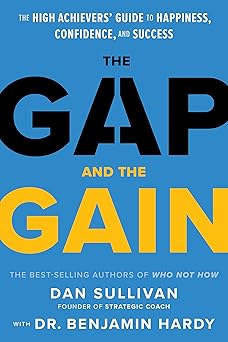
I just finished re-reading The Gap and The Gain by Ben Hardy and Dan Sullivan [1] for the Money Mental Book Club. One member captured the book’s essence perfectly: you could summarize its core message in a LinkedIn post, but you need to read it multiple times to truly internalize its principles.
The short summary of the book is that you will experience greater happiness and accomplish more when you focus not on what remains to meet your goals, but on the progress you have already made. This shift from measuring against an ideal to measuring against your starting point represents a fundamental reframing of how we evaluate success.
A few of my key takeaways from the book:
- “Ideals are meant t provide direction, motivation, and meaning to our lives. They are not the measuring stick.” Reframing goals as a way to expand rather than achieve happiness is a message that is taking me time to appreciate. It comes back to fundamentally being happy with where you are and wanting, but not needing, more. This is a subtle difference in how to think about goals and ambition, and something I am still working on. However, I believe it is key to raising my underlying level of happiness. For professionals building passive income portfolios, this addresses a critical trap. When your first syndication generates $5,000 annually and you are looking to replace a $300,000 income, you can focus on the overwhelming gap or celebrate the meaningful gain. The gap creates discouragement. The gain builds momentum.
- “You can want something and be 100% committed to that thing without needing it.” This was a difficult concept for me to grasp since we tend to think our drive must be tied to what we need to happen. However, Hardy points out that if you are already complete and happy without that thing, then you actually have the freedom to pursue it instead of trying to escape your current situation. This makes you more creative and open to different options. Desperation closes down possibilities and leads to poor decisions. Freedom allows you to evaluate opportunities objectively, pass on deals that do not meet your criteria, and maintain the patience necessary for building sustainable passive income.
- “Being self determined means that you’ve decided what success means to you, and you don’t need anyone else’s permission for what you want for yourself.” I find this extremely liberating. Too often, I feel that I need to justify what I want, and do not want, against what other people think I should want. Ultimately, that is not productive. I feel better when I am pursuing the things that I want. For high-income professionals, this means defining your own path to financial independence rather than conforming to conventional expectations about maximizing earnings or displaying wealth conspicuously.
- “Your interpretation of events, despite their objective characteristics, determines the impact of stress and illness on your body”. Hardy spends a chapter extrapolating on how your interpretation of events puts you either in a gap or gain mindset. How we interpret an event is up to us. We can change the context and the meaning we derive from it. Particularly insidious is comparing ourselves to others and how that can lead us to focus on what is missing in our lives instead of all that we have accomplished. Two investors can experience identical losses from a failed deal and emerge with completely different trajectories based solely on their interpretation. One sees confirmation of inadequacy. The other sees valuable education. The objective facts are identical, but the interpretation creates entirely different futures.
- “It is easy to miss the GAINS happening throughout our lives because we may have tunnel vision on the problem in front of us.” “You can’t move forward and grow until you have acknowledged how far you’ve come and have properly measured the GAINS” As we move past a problem, we tend to forget that we have overcome it and instead focus on the next one. Relying on our memory is not a good way to keep track of our progress. A better approach is to record your wins in a journal or other document so you can go back and review them in the future. Alternatively, stop and think about where you were ten years ago and all that you have accomplished since then. Then think about the past twelve months, and finally the past three. I am particularly bad at this and regularly discount things that have become easy for me without appreciating the wins that underlie that expertise. For investors, your first year might include reading books, attending conferences, and completing due diligence on fifteen deals before making your first investment. Without systematic recording, you might dismiss that year as unproductive because your passive income remains zero. With proper documentation, you recognize the substantial foundation you built.
- “As Thomas Edison said, ‘Never go to bed without a request to your subconsious’.” Hardy provides tactical tips on how to focus on the gain by customizing your end-of-day routine to focus on gratitude and appreciating the wins you made through the day. Not all wins will be earth-shattering, but by forcing yourself to look for them, you eventually expand what you consider to be a win and the story you tell yourself about your life eventually changes to one where you are in control. Before sleep, identify three wins from your day. Perhaps you completed financial review for a potential investment, had a productive conversation with a sponsor, or maintained your investment discipline by passing on a deal that did not meet your criteria. Recording these daily wins creates a comprehensive record of progress that would otherwise be invisible.
- “Every experience can be transformed into a GAIN.” This is a difficult lesson to keep in mind during trying times, but it remains important. If you can take an experience, even a genuinely bad one, and learn something from it, then you have made it into a gain. If you focus on that learning, then you can move forward. If you focus on the event itself, you are stuck in the past and moving forward becomes substantially harder. A failed investment that costs you $100,000 is objectively worse than a successful one. However, if you learn to identify the warning signs you missed and improve your due diligence process, you have extracted value from the experience. The financial loss remains real, but it generated learning that prevents larger future losses.
The principles in The Gap and The Gain apply broadly to personal development, but they resonate particularly strongly for professionals building passive income portfolios. The multi-year timeline, inevitable setbacks, and constant visibility of the gap between current and target income create challenges that undermine many investors’ commitment to their strategy.
Adopting a gain-focused mindset does not eliminate these challenges but changes how you process them. You maintain motivation and satisfaction throughout the journey rather than deferring all positive feelings until you reach your ultimate destination. This sustainable approach increases both the likelihood of success and the quality of experience while working toward it.
The transition from paycheck dependency to financial independence represents a marathon, not a sprint. Maintaining the psychological resilience to continue making progress for years requires more than financial knowledge and investment skills. It requires a mental framework that allows you to appreciate your progress while continuing to push forward. The Gap and The Gain provides exactly that framework.
PS: Ben Hardy has a new book out that is a sequel to 10x is Easier than 2x called The Science of Scaling. You can get a free audio copy of the book at https://www.mbc-rei.com/scaling
For additional reading, see:
The complete set of newsletter archives are available at:
https://www.mbc-rei.com/mbc-thoughts-on-passive-investing/
This article is my opinion only, it is not legal, tax, or financial advice. Always do your own research and due diligence. Always consult your lawyer for legal advice, CPA for tax advice, and financial advisor for financial advice.